Accelerated Nursing Programs (ABSN): The Fast Track to RN
An ABSN condenses a four-year BSN into 11-18 months for career-changers who already hold a bachelor's degree in another field. Here's who qualifies, what it really costs, how to verify accreditation, and what happens between graduation and your RN license.
Editorial
Last reviewed · July 17, 2026
Are you thinking of a career change? Maybe nursing has recently caught your interest, or you’re looking for a career that's more stable and has opportunities for you to grow. The good news is that if you have a bachelor’s degree in any field, you don’t have to begin from scratch to pursue your nursing dream.
An Accelerated Bachelor of Science in Nursing (ABSN) is designed for people who want to change careers. It lets you build on your previous education and earn a nursing degree in just 11 to 18 months. If you want to know how these programs actually work, how much they cost, or if it's the right move for you, this article breaks it all down.
What is an accelerated nursing program (ABSN)?
An Accelerated Bachelor of Science in Nursing is a fast-track nursing program designed for people who hold a bachelor’s degree in a non-nursing field and want to become registered nurses (RNs). The American Association of Colleges of Nursing describes it as one of the quickest ways to get an RN license, because you skip the general education courses you already completed and move straight into nursing-specific coursework.
Accelerated nursing programs are so intensive because they condense a full four-year BSN curriculum into 11 to 18 months. As a result, you must be willing to make a full-time commitment, as you will have very little time left for outside work. When you graduate, you’ll have a Bachelor's Degree in Nursing and can sit for the NCLEX-RN exam afterwards to become a registered nurse. Prepping for this exam can be another challenge, especially after such an intense program, and Testavia’s NCLEX-RN study resources can help you walk into that exam feeling solid.
If you are still deciding between degree routes rather than committing to the accelerated one, our breakdown of ADN vs BSN covers what each credential opens up.
Do you qualify? Prerequisites and admissions
Eligibility for an ABSN comes down to two things: a completed bachelor’s degree in any field, and a set of science and general-education prerequisite courses finished before you apply. Holding the degree alone is not enough. Schools also set a minimum GPA, ask for transcripts, and often require recommendation letters, a personal statement, or an interview. Every program publishes its own list, so check the school directly.
Prerequisite Courses
An ABSN program requires you to complete several science and general education courses. Common prerequisites include:
Human Anatomy and Physiology I & II (no lab work required)
Microbiology (no lab required)
Chemistry (no lab required): They accept courses like Basic Chemistry, Introduction to Chemistry, and Chemistry for Health Professionals.
Statistics
Human Growth and Development (Developmental Psychology)
Human Nutrition
General Psychology
You should keep in mind that these requirements vary depending on the school you apply to. If you didn’t cover these units in your previous degree, you can take them at a community college or an approved online institution before you apply. Our full guide to nursing school requirements walks through how programs weigh prerequisites against GPA.
Academic Requirements
Most schools require applicants to:
Have a bachelor's degree from an accredited college or university
Meet the minimum GPA (typically between 2.5 and 3.0)
Submit official transcripts from everywhere you studied
Provide letters of recommendation if required
Write a personal statement that explains why you want to become a nurse
Some schools require you to do an admission interview
Apart from these, some ABSN programs require you to take an entrance exam, such as TEAS or HESI A2. That's why it's important for you to check the specific admission criteria from the school you’re considering.
How long is an ABSN, and what's the format?
According to the American Association of Colleges of Nursing, ABSN programs take 11 to 18 months to complete. However, the exact duration depends on the school due to prerequisites, transfer credits, and program structure. It moves at such a fast pace because there’s no summer break or gaps between the semesters, and the pace stays steady from the beginning to the end of the semester. For context on the alternatives, see how long nursing school takes on the traditional routes.
During this period, you should not continue working because an ABSN program is a full-time sprint. In those months, you will be moving through coursework, lab, and clinical rotations back-to-back. This leaves very little room for other commitments on the side.
It’s worth noting that accelerated nursing programs are not fully online. Some schools will advertise the program as hybrid, but that only applies to the classroom coursework, since lectures and readings don’t require you to be physically present. However, for lab work and clinical rotations, they must be in person.
The ABSN structure falls into three parts:
Classroom Coursework: This covers all theoretical content, from pharmacology and pathophysiology to the basic rules of nursing. This part is mostly online.
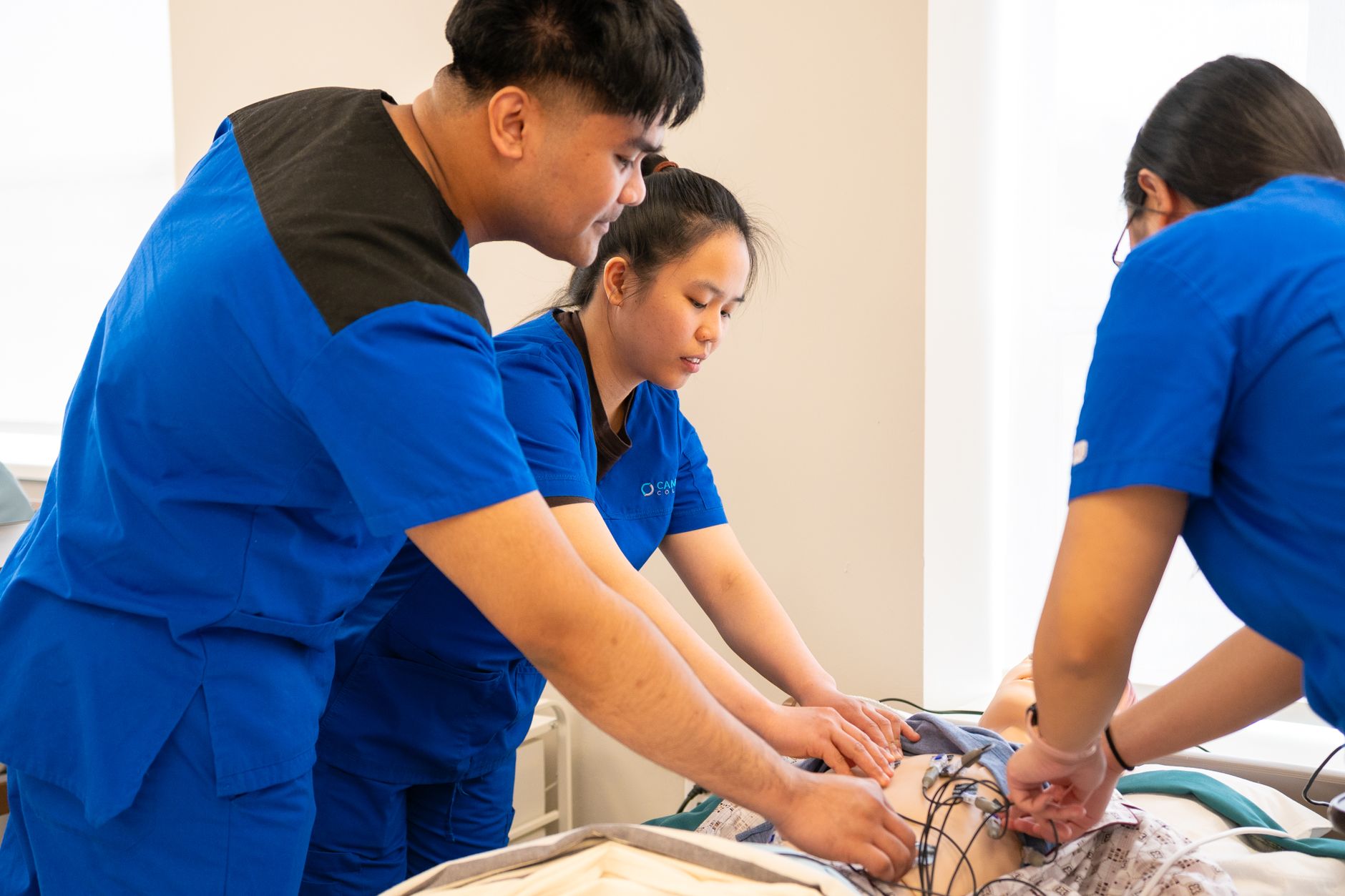
Skills Labs and Simulations: Here, you put the theoretical knowledge into practice. You practice procedures like inserting an IV line or working through a mock patient scenario. This is done on campus, where you can practice on mannequins or simulated patients.
Clinical Rotations: You’ll be placed in hospitals or clinics to work with real patients under supervision. During these rotations, you’ll move through different specialties like med-surg, pediatrics, and obstetrics to give you exposure to different fields before you graduate.
Cost, accreditation, and choosing a program
Tuition for accelerated nursing programs varies widely, and the number on the school’s website is rarely what you actually pay. Three things move it most: whether the school is public or private, how many prerequisite credits you can transfer in, and your in-state residency status. On top of tuition you also carry fees, equipment, transportation, and living costs during months when working is not realistic. Accreditation status should be verified before any of that matters.
You can do the following things to lower the tuition cost:
Choose a public in-state university, because they’re generally cheaper than private universities.
Apply for financial aid to make you eligible for student loans and federal grants.
Complete prerequisites at a community college.
Apply for scholarships and grants — our guide to nursing school scholarships and financial aid lists where to look.
Apart from the tuition costs, you should also include the cost of:
Application and enrollment fees
Books and digital learning resources
Uniforms, scrubs, and medical equipment, such as a stethoscope
Transportation to clinical sites
NCLEX-RN and licensure fees after graduation
Basic living expenses like rent and groceries
Before you enroll, you should check if the ABSN program is accredited. In the US, the two main accrediting bodies for nursing are the Commission on Collegiate Nursing Education (CCNE) and the Accreditation Commission for Education in Nursing (ACEN). To check whether a program is accredited, search for it on either of the two websites rather than trusting a school's claim about its accreditation status. This step is very important because it affects your future education and career opportunities. For instance, many employers hire graduates from accredited institutions.
So how do you choose the right ABSN program? Here are the criteria that matter most:
Check accreditation status: This is the most crucial step, because it determines whether you will be eligible for licensure.
NCLEX-RN pass rate: A school with a higher pass rate shows that it prepares its students well for the licensing exam — here is what NCLEX pass rates actually mean when you compare programs.
Program length and schedule: Although the AACN states that ABSN programs take 11-18 months to complete, some programs may extend this timeline. Also, some programs offer multiple start dates per year, which is important to check if your timeline is tight.
Tuition and financial aid: You should compare fees, scholarship opportunities, and financial aid to make a cost-effective decision.
Student support services: Since the ABSN program is so intense, you may wear out. That’s why you should pick a program with academic advisors and mental health resources to encourage you to keep pushing and offer insights on how to manage the demanding workload.

ABSN vs. ADN vs. traditional BSN vs. RN-to-BSN
The right route depends entirely on what you already hold. If you are starting from a high school diploma, an ADN or a traditional BSN is your entry point. If you already hold a bachelor’s degree in another field, the ABSN is the fastest path to an RN license. If you are already a licensed RN with an associate degree or diploma, RN-to-BSN finishes the bachelor’s without redoing credits you have already earned. The table below sets them side by side.
Path | Who It's For | Entry Requirement | Typical Length | Outcome |
|---|---|---|---|---|
ADN | New nursing students starting from scratch | High school diploma or equivalent | About 2 years | RN license (via NCLEX-RN) |
Traditional BSN | First-time college students or those without a bachelor's degree | High school diploma or equivalent | 4 years | RN license + BSN |
ABSN | Career-changers with a non-nursing bachelor's degree | Bachelor's degree in any field, plus prerequisites | 11–18 months | RN license + BSN |
RN-to-BSN | Already-licensed RNs with an ADN or diploma | Active RN license | 12–24 months | BSN only |
After the ABSN: the NCLEX and licensure
Finishing an Accelerated Bachelor of Science in Nursing is not the end of the road. That's because the degree alone does not make you a registered nurse. After you graduate, you have to apply for licensure through the state's board of nursing. This is the point where graduating from an accredited program comes into play. According to the National Council of State Boards of Nursing, you have to graduate from a state-approved nursing program to be eligible to sit for the NCLEX-RN exam.
The process from graduation to receiving an RN license looks like this:
Graduate from an accredited ABSN program
Apply for your license at your state’s board of nursing
Take and pass the NCLEX-RN exam
Get your RN license and begin practicing
The purpose of the NCLEX-RN exam is to test if you have the knowledge and clinical judgment to provide safe and effective patient care. Because an ABSN compresses so much content into so little time, most graduates need a deliberate review plan — our guide on how to study for the NCLEX lays out how to build one. After you pass your NCLEX-RN, you can immediately start working to gain clinical experience. You can also go for specialty certifications or advanced degrees like an MSN or DNP. It's up to you.
Written by · Verified educator
Testavia editorial
Nathan Cole
RN
Medical-Surgical nurse & health writer
Meet Nathan, a registered nurse with over five years of experience in Medical-Surgical care, based in New York City. Having worked with a wide range of patients through some of their most vulnerable moments, Nathan brings a grounded, real-world perspective to his writing on healthcare. His goal is simple: to bridge the gap between medical knowledge and everyday understanding, making health topics feel less intimidating and more empowering for everyone. When he's not caring for patients, Nathan channels his passion for medicine into writing that educates, comforts and inspires.
5+
Years in Med-Surg
Medical-Surgical
Specialty
New York City
Based in