Nursing Exams Explained: From Entrance to Certification
Nursing exams come in four stages and each has a different purpose: entrance exams screen academic readiness, in-program assessments track mastery, the NCLEX grants licensure, and certifications open specialties. Preparing for the wrong stage is the most common and most avoidable waste in the sequence.
Editorial
Last reviewed · August 3, 2026

There is no single nursing exam. There is a sequence, and each stage has its own name, purpose and deadline. Nobody hands you that map when you start, which is why students routinely prepare for the wrong test or prepare a year too early.
Most guides assume you already know the difference between getting into school and getting licensed. This one does not. It lays out the four stages in order, so you can find where you are standing and ignore everything else for now.
The four stages
Think of it as four doors, each needing a different key. A licensure key does not open an entrance door, and that mismatch is where most confusion begins. The stages run in a fixed order, they take years rather than months to move through, and only one of them is legally required to practice. Knowing which door you are standing at determines what you should be studying this week, and it is the single question most nursing-exam advice fails to ask before answering.
Stage | Exams | What it checks | Who takes it |
|---|---|---|---|
Entrance | TEAS or HESI A2 | Academic readiness in math, reading, science and English | Pre-nursing applicants |
In-program | ATI proctored assessments, HESI Specialty and Exit | Course mastery and NCLEX readiness | Current nursing students |
Licensure | NCLEX-RN or NCLEX-PN | Practice readiness and clinical judgment | Program graduates |
Certification | BLS, ACLS, PALS, CCRN | Specialty skills beyond licensure | Working RNs and LPNs |
How the stages connect
They are not independent. Performance at one stage shapes how the next goes.
Entrance exams open the door to your program
In-program exams keep it open and rehearse the content the NCLEX will test, by design
The NCLEX grants the license to practice
Certifications determine where you specialize afterward
Strong in-program scores correlate with stronger NCLEX outcomes because the content overlaps deliberately. Passing the NCLEX opens the door to certifications but does not require them.
Why this matters
Searching "nursing exam" returns a pile of unrelated study guides: some entrance, some licensure, all mixed together. The cost is real. Students who prepare for the wrong stage burn weeks on content they will not be tested on for another year.
Find your row above. Everything below builds from there.

Entrance exams: TEAS and HESI A2
These test academic readiness, not nursing knowledge, which is the single most useful thing to understand about them. You are being screened on whether you can handle the coursework, so studying nursing content at this stage is wasted effort.
What the TEAS covers
The TEAS is built and maintained by ATI and tests four areas: reading, mathematics, science, and English and language usage. Science carries the heaviest weight, and anatomy and physiology dominates it. Our guide to the ATI TEAS covers the section breakdown and scoring.
What the HESI A2 covers
The HESI A2 is developed by Elsevier and is modular, which is the key structural difference: your program chooses which subtests you sit, so two applicants to different schools may take substantially different exams under the same name. Sections include reading comprehension, vocabulary and general knowledge, grammar, mathematics, and the science subtests. Our guide to what the HESI A2 exam is covers the full list and how to prepare only the sections your program actually requires.
Which one will you take?
Your program decides, and you do not choose. Some accept either, most specify one. Confirm before you buy anything, because the two exams differ enough that preparation does not transfer cleanly.
Whichever applies, focus on academic readiness content rather than generic nursing material. That is what is being measured at this stage.
When to schedule
Early enough to retake if needed. Most programs allow multiple attempts within an eligibility period but impose a waiting interval between them, and application deadlines do not move. Working backward from the deadline, allowing for one retake, is the sensible way to pick a date.
In-program exams: ATI and HESI
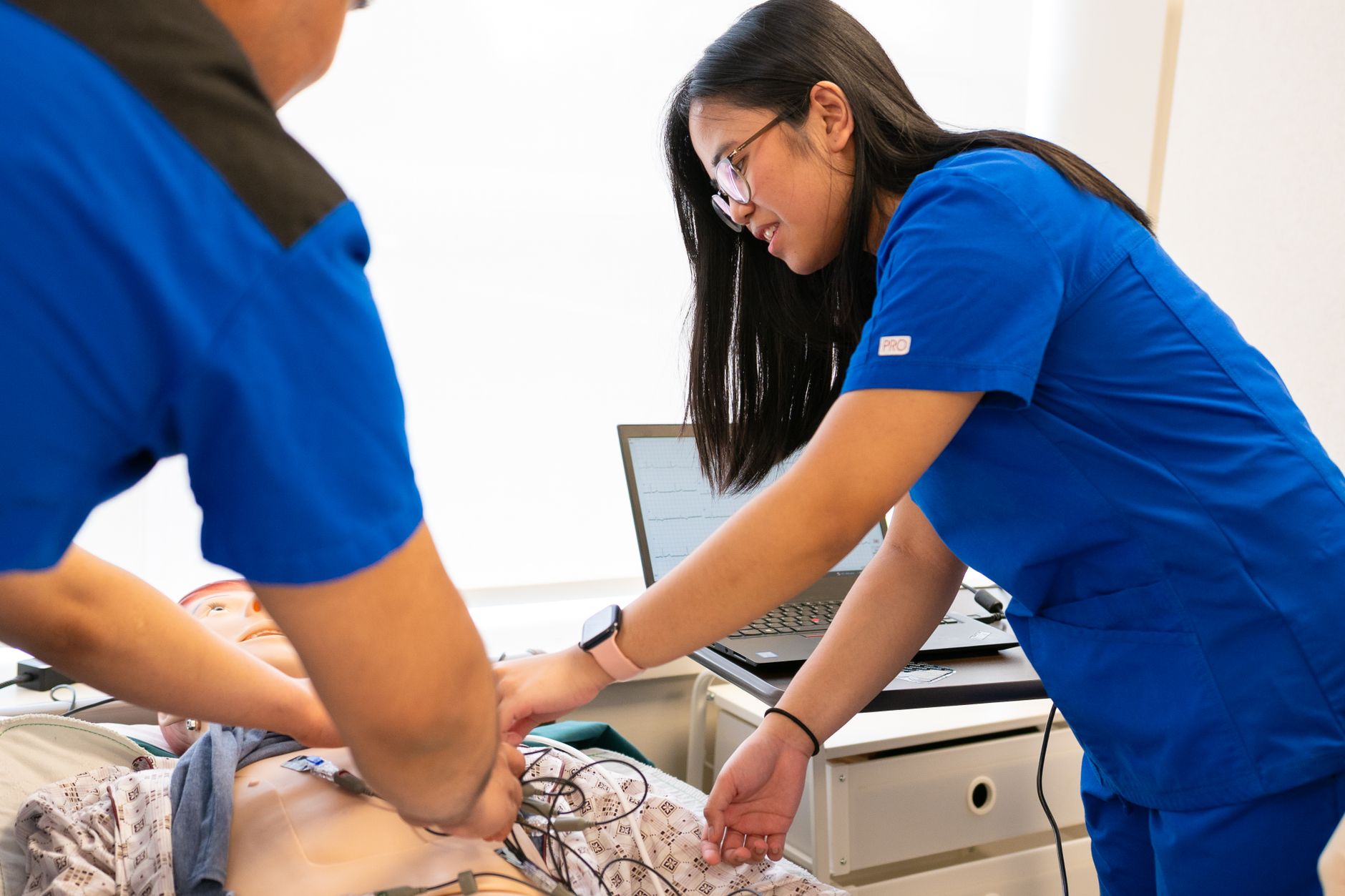
Once you are in a program, exams shift purpose. They are no longer screening you for admission; they are tracking mastery and predicting how you will do on the NCLEX.
ATI proctored assessments are given at the end of content units and scored against benchmark levels. HESI Specialty exams test individual subject areas such as maternity, pediatrics or med-surg, and the HESI Exit exam is a comprehensive predictor many programs use as a graduation requirement or progression gate.
These are not busywork
Two reasons they matter more than they appear.
First, many programs attach consequences: a minimum score to progress, to graduate, or to be cleared to sit the NCLEX. Check your handbook rather than assuming.
Second, they are built to predict NCLEX performance, which means the content overlaps heavily and by design. Treating them as a rehearsal rather than an obstacle changes what you get out of them. Our guide to the HESI Exit exam covers how the prediction works.
Habits that carry into the NCLEX
Review the rationale for every missed item rather than only the score. Practice under time. Track which content areas recur in your errors rather than which exams you found hard. All three transfer directly to licensure preparation, and building them now means arriving at NCLEX prep with the method already in place.
Licensure: the NCLEX
The one exam you cannot skip or substitute. According to NCSBN, the NCLEX uses computerized adaptive testing, adjusting difficulty question by question rather than serving everyone a fixed set. Our guide to how that adaptive format decides pass or fail covers the stopping rules.
RN vs PN
NCLEX-RN | NCLEX-PN | |
|---|---|---|
Who takes it | ADN, BSN and diploma graduates | Practical and vocational nursing graduates |
Governing plan | NCLEX-RN test plan | NCLEX-PN test plan |
Care category | Management of Care | Coordinated Care |
Leads to | RN licensure | LPN/LVN licensure |
They are genuinely different exams rather than harder and easier versions of one, as the LPN NCLEX guide sets out.
What it tests
Clinical judgment rather than recall: recognizing cues, prioritizing, choosing interventions, evaluating outcomes. Since April 2023 that has included Next Generation item types built specifically to measure the reasoning.
The path to sitting it
Apply to your state board for licensure eligibility, clear the background check, register with Pearson VUE, and receive an Authorization to Test. Only then can you schedule. The two applications run in parallel rather than in sequence.
After you pass
Your board issues the license. That is the official result, not the exam score, and there is no numeric score to receive.
Post-licensure certifications
Once licensed, exams stop being gates and become strategic. You take them because a role requires them or because holding one opens a role, and nobody makes you sit any of them to keep practicing. This is the first stage where you choose rather than comply, and the choices are driven by the unit you want to work in rather than by a curriculum. Four come up most often.
BLS — the baseline resuscitation credential, required of essentially all clinical staff
ACLS — adult advanced resuscitation, standard for ED, ICU, PACU and telemetry
PALS — the pediatric equivalent
CCRN — critical care specialty certification, requiring documented bedside hours
Our guides to what ACLS is and CCRN practice cover the two most commonly asked about.
Who needs them
Employer and unit driven. BLS is close to universal. ACLS is a condition of employment in most acute-care settings. Specialty certifications such as CCRN are usually optional but materially affect hiring and pay.
They expire
This is the part people forget. Resuscitation credentials typically run two years, and specialty certifications carry renewal requirements including continuing education and sometimes practice hours. Certification is a cycle rather than an achievement.
Written by · Verified educator
Testavia editorial
Nathan Cole
RN
Medical-Surgical nurse & health writer
Meet Nathan, a registered nurse with over five years of experience in Medical-Surgical care, based in New York City. Having worked with a wide range of patients through some of their most vulnerable moments, Nathan brings a grounded, real-world perspective to his writing on healthcare. His goal is simple: to bridge the gap between medical knowledge and everyday understanding, making health topics feel less intimidating and more empowering for everyone. When he's not caring for patients, Nathan channels his passion for medicine into writing that educates, comforts and inspires.
5+
Years in Med-Surg
Medical-Surgical
Specialty
New York City
Based in